


Chaffey Trail a story of Australia's first irrigation colony
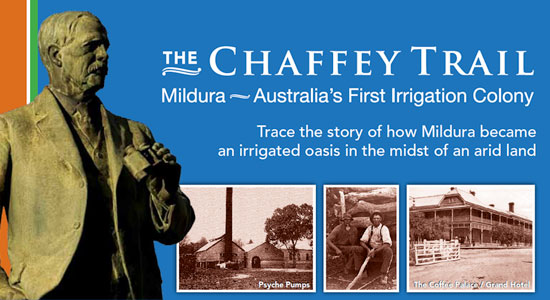
The Chaffey Trail is the story of how Mildura became an irrigated oasis in the midst of an arid land. In 1847 the Jamieson brothers took up the pastoral lease which was later to be named Mildura.
George and W.B. Chaffey were developing an irrigation settlement in Ontario, California when they met the Victorian Cabinet Minister Alfred Deakin. Deakin was appointed by the Victorian Parliament to visit America on a fact finding mission.
The Chaffeys’ model irrigation settlement impressed Deakin who in turn impressed them with the potential for irrigation from the Murray River in Australia.
The Chaffey brothers subsequently came to Australia and, after protracted negotiations, in 1887 purchased the then defunct pastoral lease and created the Mildura Irrigation Colony.
The Chaffeys adapted the plan of Ontario to the present site of Mildura. They developed a series of steam-driven pumps to lift the water from the Murray River, first into Kings Billabong, then subsequently to various heights to irrigate up to 33,000 acres.
The Chaffey brothers wanted to make Mildura a vibrant community. Their plans included many visionary concepts: an agricultural college was needed and to finance this they allocated one-fifteenth of the land to be for College leases, which has provided support funding for schools over many years. Prominent locations were made available for churches and facilities for clubs were encouraged. Parks and town transport were considered – together this gave us the beautiful centre plantation of Deakin Avenue, surely one of the finest thoroughfares in Australia. Lanes and streets were laid out in all the town planning making Mildura the beautiful place it is.
Now you can trace the developments of Mildura through the Chaffey Trail.
Mildura Visitor Information & Booking Centre
The Chaffey story begins with a wonderful interpretation and film about the Chaffey brothers at the centre. You are invited to view the informative video production of the “Chaffey Trail” in the theatrette, detailing the history of irrigation in the region and the Chaffey brothers. Open 7 days showing every half hour commencing at 9.30am with the last film screening at 4.30pm. 180-190 Deakin Avenue, Mildura. Telephone (03) 5018 8380.
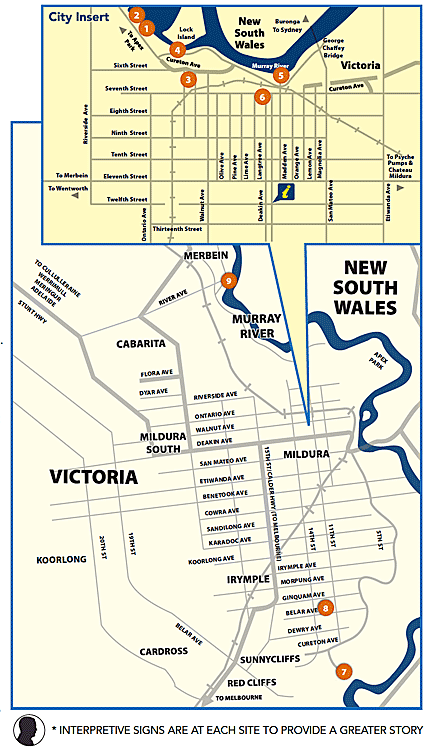
1. The Old Mildura HomesteadSituated on the original site in Cureton Avenue, formerly known as Mildura Station Homestead. It is a reconstruction of the first Mildura station established by the Jamieson brothers in 1847. It was here that the Chaffey vision for the irrigation colony evolved. It was the success of the fruit trees around the homestead that were watered from the river which demonstrated the potential of the irrigated settlement. The re-creation consists of the homestead, outbuildings, the wool-shed and rose garden. |
![]() |
|
2. Mildura Homestead CemeteryMildura’s earliest cemetery includes graves of some early pioneers and members of the Chaffey family. Antonia Chaffey, great grand daughter of W.B. Chaffey, has designed a commemorative garden beside the burial site of the mother of the Chaffey brothers, Ann Maria and W.B.’s first wife, Hattie Schell, as well as four infants. The commemorative garden comprises a granite sculpture and observation seat, with the inscription “Memento Matrem”, Latin for “Remember the Mother”. |
![]() |
|
3. Rio Vista HouseRio Vista was the home of W.B. Chaffey, it is Spanish for “River View”. Designed by architects Sharland and Edmunds in the classical asymmetrical villa form, it was completed in 1890 by the Adelaide builder John Williams. The house boasts wide verandahs, cedar and jarrah panelling, Italian marble fire places and Victorian leadlight and stained glass windows. |
![]() |
|
4. Lock 11 & Mildura WeirIn its natural state, the Murray River was quite different from the regulated river we see today. During droughts it was often reduced to a series of waterholes. The locks and weirs on the river were built to provide a constant level for both irrigation and navigation by paddle steamers. Construction of the Mildura Lock and Weir began in 1923 and finished four years later. You can visit the lock and Lock Island. The Mildura Weir is the only one on the Murray River where the lock and weir are separated by an island. |
![]() |
|
5. Mildura Wharf / Port of MilduraRiver transport played a very important part in the opening up of the settlement of Mildura. The Mildura Wharf was completed in 1892 by A. McPherson of Kerang. It was then extended in 1899 and three additional levels were added to accommodate vessels at various river heights. In the early 1900’s, before railways began to make an impact, this region depended almost entirely on paddle steamers to bring everything required for the successful operation of the land and to send grapes and citrus products to market. Today you can experience travelling on the Murray by paddle steamer offering a variety of cruises or special charters. |
![]() |
|
6. Mildura Grand HotelMildura was established as a temperance colony and the Grand Hotel was originally the Mildura Coffee Palace. The Chaffey offices were next door but were later demolished to make way for the expansion of the Grand. The fountain at the Grand, the only remaining relic of the Chaffey Office, was brought to Mildura on the paddle steamer Gem together with another fountain that originally stood in front of Rio Vista House. Several titles over more than a century existed, but it is generally known as Mildura Grand Hotel. |
![]() |
|
7. Psyche Pumps / Kings BillabongTo create an irrigation settlement, pumps were needed to lift water to the height of the land. It was a height several times that of the lift of the pumps of the day. It was solved by lifting water first to Kings Billabong, then progressively through other pumps to the height required. The pump at Psyche Bend was a revolutionary design of George Chaffey. It was a triple expansion steam engine connected to three centrifugal pumps and driven by a wood burning boiler. Visitors to Psyche Bend can experience the original pump house, reconstructed pumps, steam engine and boiler house. Kings Billabong is a wetland reserve and bird sanctuary with bird hides. |
![]() |
|
8. Chateau MilduraIn 1888 the Chaffey brothers planted 150 acres of wine grapes on their Belar Avenue property ‘Chateau Mildura’ commencing the region’s wine industry. Chateau Mildura became part of Mildura Wines, then later Mildara Wines specialising in the production of brandy and sherries until the late 1990’s. In 2002, the property was purchased by a local (4th generation) horticulturalist who has taken the historic complex back to its original purpose of table wine production. A large section of the building now houses a museum containing a unique collection of wine related items. |
![]() |
|
9. Merbein Chaffey LinksStarting from the Merbein Rotary Lookout at the top of the white cliffs, which are a unique geological feature and the district’s highest point, look to the right, you will see Victoria’s first Government owned irrigation pumps, then walk to the left through Pioneer Plantation passing the distillery/winery that was established by W.B. Chaffey in 1913 and where he sadly collapsed and died in 1926. The original Mildara Distillery is heritage listed. The sandstone walk takes you down to the Chaffey landing. Grape spirit was once loaded from here on onto paddle steamers. Also at Chaffey Landing is the William Blandowski Cairn, the site of the Victorian Government Zoologist camp in 1857. New interactive walking tracks, encompassing the nearby Merbein Common and floodplains are now open. |
![]() |
|
Further links of the Chaffey Story |
||
Deakin AvenueThe Mildura township was mapped out on the lines of the successful Chaffey irrigation colony of Ontario in California. Deakin Avenue was named after Alfred Deakin, the Victorian Cabinet Minister who introduced the concept of an irrigated settlement in Australia to the Chaffeys. The main thoroughfare is straight, broad and long, running from Seventh Street for twelve kilometres southwest. Its centre section, originally reserved for a tramway, is now a landscaped median strip lined with a double row of shade trees planted by W.B. Chaffey himself. |
![]() |
|
Carnegie CentreThe Carnegie Centre beneath the famous clock tower is now home to the historical and genealogical societies and has within it an enormous amount of historical material. It was however built as the Carnegie Library, so called from Andrew Carnegie’s bequest of two thousand pounds for its construction. For ninety years it was Mildura’s public library until the building of the Alfred Deakin Centre. The addition of the tower, as a memorial to those who fell in the First World War, came in 1922, and the names of those who died are to be found on either side of the front door. |
![]() |
|
Langtree HallA well-known tourist attraction, right near the town centre, 79 Walnut Avenue, the privately owned museum has a stunning collection of district memorabilia. Originally situated in Langtree Avenue, the Langtree Hall was Mildura’s first public hall built in 1889. It was first used as a skating rink, Court of petty sessions, church services, musical nights for dances and concerts, then the “Mildura Telegraph” newspaper printing office, then later as a billiard saloon. |
![]() |
|
Settlers Club MilduraThe Settlers Club began its illustrious history in 1893, and early members tended to be professional people and the more successful block owners. Regrettably, after being a great success for so long, it ran into financial difficulties and closed just short of its centenary in 1993. It is now a very successful function centre, and a popular place for having meals and gathering in a convivial atmosphere - as it was when it was the original club. The building is located at the corner of Eighth Street and Orange Avenue. |
![]() |
|
Mildura Workingmans ClubSome of the more significant members of the Mildura community felt that there was no need for a club for the workers, and (remembering that the community began as a temperance colony) the idea of making alcohol available to pickers was frowned upon. But perseverance paid off and in 1894 the Workingmans Club was born. The first premises were in Madden Avenue, and the present site was acquired in 1908. The building took on a more familiar form in 1935 when the upper floor was added. The war memorial in front was added in 1920. The club became noted in the Guinness Book of Records for having had the world’s longest bar which was removed in recent renovations. |
![]() |
|
Mildura ClubThe Mildura Club’s first president was the remarkable Lord Ranfurly who took the position in 1890. Early meetings were at the Coffee Palace (later the Grand Hotel) until their own premises were built at 29 Deakin Avenue. The present building, at the corner of Deakin Avenue and Ninth Street, was erected in 1920 at a cost of 5500 pounds. The imposing entrance is adorned with Ionic pillars, and the interior retains its period flavour. |
![]() |
|
Reprinted with permission from the Mildura Rural City Council. For further enquiries and updates, please contact the Chaffey Trail Project Officer on 03 5018 8311, or email chaffey.trail@mildura.vic.gov.au. Visit www.thechaffeytrail.com.au website.
Disclaimer: Whilst every endeavour has been made to ensure complete accuracy, the publisher cannot be held responsible for any errors, changes or omissions. Times and prices subject to change without notice.
Discover: Mildura | Renmark | Paringa | Riverland
Of related interest: Olivewood in Renmark | Early Irrigation of the Murray River
Tell your friends you found this at murrayriver.com.au!
Copyright Discover Murray 2010. This site or any portion of this site must not be reproduced, duplicated, copied, sold, resold, or otherwise exploited for any commercial purpose that is not expressly permitted by DISCOVER MURRAY.